
The kpuas Standard: Engineering Executive Summary
kpuas is a specialized engineering studio dedicated to the structural optimization of high-fidelity flight simulation hardware. We bridge the gap between consumer-grade mounting solutions and the high-torque demands of modern force-feedback avionics.
Our Technical Commitment:
- Validated Design: Every kpuas component is modeled and structurally validated using SOLIDWORKS® Premium. We utilize Finite Element Analysis (FEA) to simulate stress distribution and ensure zero-deflection under maximum flight loads.
- Precision Metrology: To achieve a “zero-play” interface, we utilize Revopoint high-resolution 3D scanning to acquire 1:1 digital twins of OEM chassis, allowing for tolerances as tight as ±0.15mm.
- Aerospace Materials: We move beyond hobbyist-grade plastics, utilizing Carbon Fiber Reinforced Polymer (CFRP). This material matrix offers superior thermal stability and the high-modulus rigidity required for long-term structural integrity.
Precision Engineering for the Virtual Cockpit.
The kpuas Guarantee
Designed by a Pilot. Engineered in the USA.
We don’t ship anything we wouldn’t bolt to our own rig. Whether you are building a procedural trainer or a full home cockpit, kpuas delivers the tactile fidelity you need to stay in the immersion.
Precision Hardware. Built for the Mission.
At kpuas, we believe there is a massive difference between “playing a game” and “training for flight.” That difference lies in the hardware.
We don’t mass-produce cheap, hollow plastic toys. We engineer composite avionics components designed to withstand the rigors of serious simulation. Every throttle quadrant, lever, and panel we ship is manufactured in the USA using industrial-grade materials and processes.
Here is the kpuas standard.
1. The Material: Carbon-Fiber Reinforced Polymer (CFRP)
Real aircraft don’t feel like glossy plastic, and neither should your simulator. We manufacture exclusively with Carbon Fiber Infused Filament.
- Tactile Realism: The microscopic carbon fibers embedded in the matrix create a natural, matte finish that absorbs light rather than reflecting it. This eliminates the “toy-like” shine of standard 3D prints and provides a surface texture that grips your hand securely.
- Structural Rigidity: Carbon fiber increases the tensile strength and stiffness of our parts. When you slam a throttle forward or make a precise mixture adjustment, you won’t feel the flex or “squish” common in entry-level gear.
- The “Disappearing” Act: Our design philosophy is that good controls should disappear. By using materials that mimic the thermal and tactile properties of real cockpit controls, your brain stops focusing on the plastic and starts focusing on the flying.
2. The Connection: Brass on Carbon
A flight simulator rig is a dynamic environment. Controls are swapped, adjusted, and tightened constantly. We never rely on screws biting into raw plastic, which strips and loosens over time.
- Heat-Set Brass Inserts: Every mounting point and pivot screw in a kpuas product utilizes Threaded Brass Inserts. These are heat-set permanently into the Carbon Fiber matrix.
- Metal-on-Metal Reliability: When you mount our gear, you are tightening a steel bolt into a brass anchor. This allows you to torque down your hardware without fear of cracking the chassis, ensuring zero wobble even during heavy turbulence simulation.
3. The Process: Tungsten Carbide Precision
Consistency is not an accident; it is engineered.
We utilize state-of-the-art Bambu Lab printers equipped with Tungsten Carbide extrusion systems.
- Why Tungsten Carbide? Carbon fiber is abrasive—it eats through standard steel nozzles, causing inconsistent flow and poor tolerances. By using Tungsten Carbide (one of the hardest materials on earth), we ensure that the 1,000th part we make is dimensionally identical to the 1st.
- Thermal Consistency: This technology maintains perfect internal temperatures, ensuring that the carbon fibers are distributed evenly throughout the layer lines for maximum strength and finish quality.
ENGINEERING STACK
- DESIGN: SOLIDWORKS® Premium
- VALIDATION: FEA Stress Mapping
- METROLOGY: Revopoint 3D Scanning
- MATERIAL: High-Modulus CFRP
- HARDWARE: Heat-Set Brass Inserts
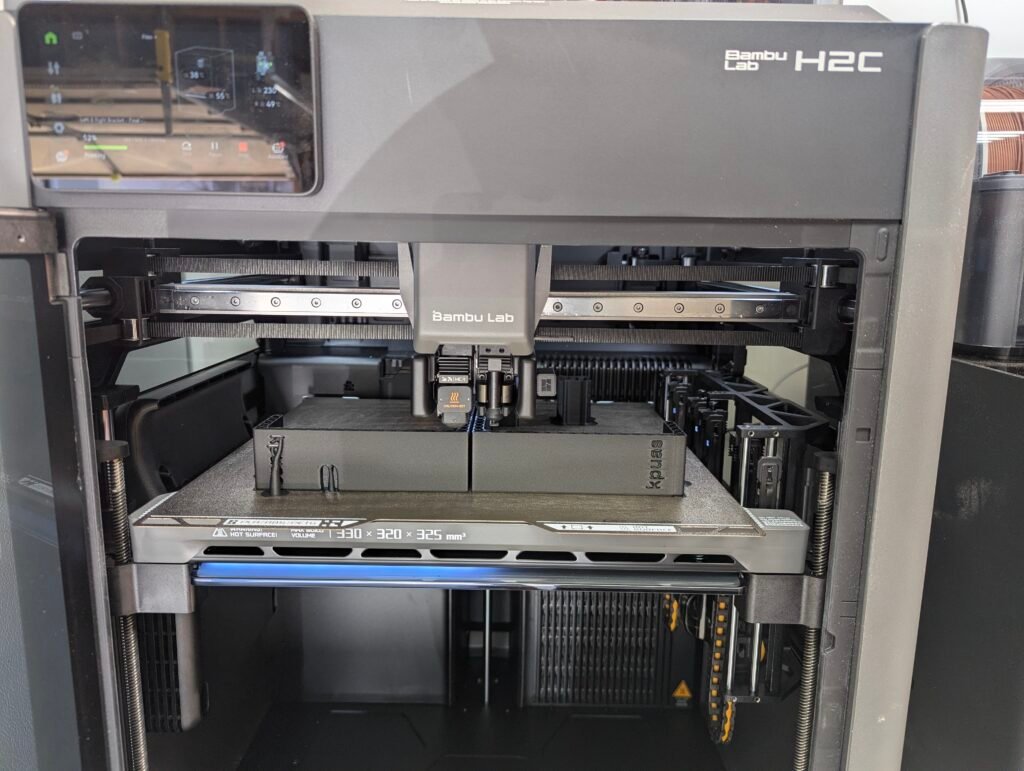
Structural Integrity: Beyond the Surface
True engineering is what you can’t see once the part is installed. In Photo, we highlight the internal Gyroid Infill Matrix of the v2.1 bracket. Unlike standard ‘hollow’ prints, kpuas components utilize a high-density internal lattice optimized for multidirectional torque resistance. This internal geometry, combined with our 15% Carbon Fiber reinforcement, prevents the structural ‘creep’ common in consumer mounts, ensuring your flight rig remains rigid for years of high-G maneuvers.”