
Our Reverse Engineering & Part Restoration Process
At KPUAS Restoration Workshop in Chesterfield, Virginia, we specialize in transitioning physical components into precise, manufacturable digital assets for legacy automotive restoration and custom mechanical reverse engineering. Whether reproducing a discontinued automotive part, reverse-engineering a broken mechanical component, or capturing complex organic geometry, we utilize a strict, closed-loop industrial workflow to ensure absolute accuracy.
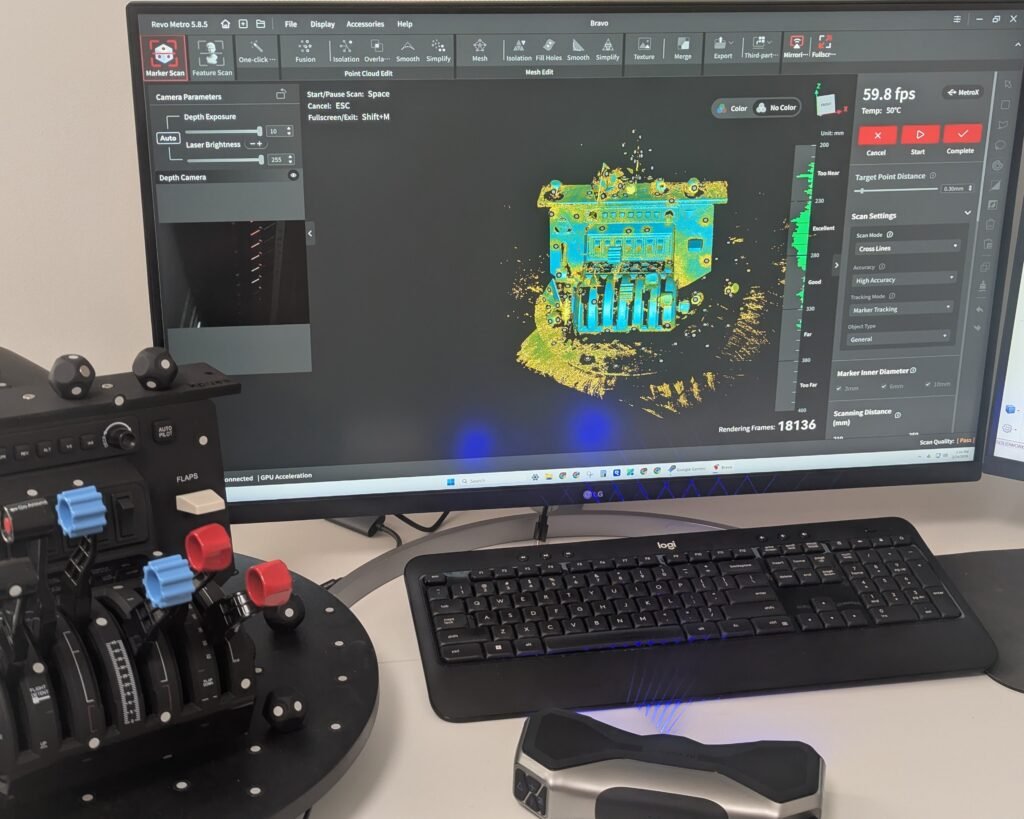
Phase 1: Project Assessment & Preparation
We begin by evaluating the physical component to determine the critical dimensions, mounting points, and structural requirements. For legacy or salvaged parts, this includes professional cleaning and surface preparation to ensure high-fidelity optical tracking without damaging the original geometry.
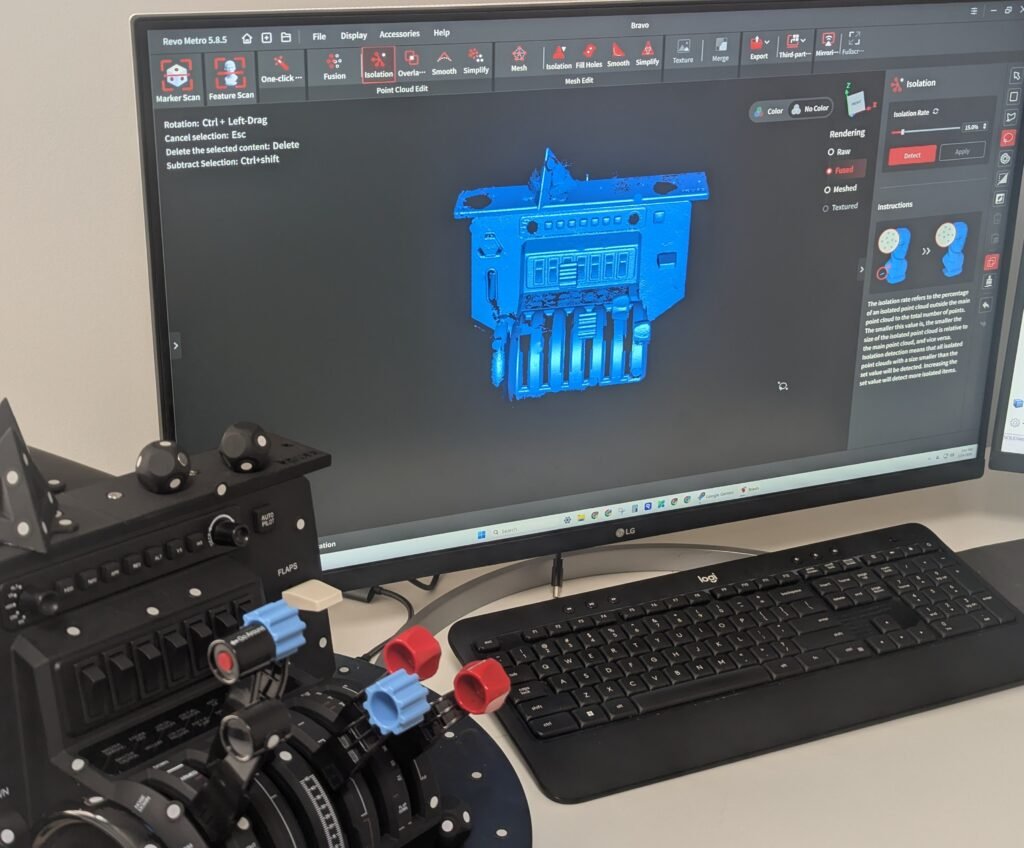
Phase 2: High-Resolution Digital Capture
Using advanced metrology equipment, including the Revopoint MetroX blue laser 3D scanner, we capture the physical object’s exact geometry. We focus heavily on resolving complex hybrid surfaces—ensuring obsolete organic cast contours and precision mechanical mating surfaces (like gasket faces and bolt bores) are digitized with sub-millimeter accuracy.
Phase 3: Geometry Extraction & Surfacing
Raw scan data is not a final product. We process the captured mesh through specialized reverse-engineering software to extract foundational geometric primitives (planes, cylinders, cones) and rebuild complex freeform surfaces. This bridges the gap between a frozen point-cloud and a functional digital body.
Phase 4: Parametric CAD Translation
The extracted geometry is pushed directly into SolidWorks Premium, where the part is meticulously rebuilt from the ground up. Rather than providing a “dumb” mesh, we create a fully editable, history-based parametric CAD model. This allows us to not only duplicate the part but to repair physical damage, correct warpage, and extrapolate broken features back to factory specifications.
Phase 5: Physical Validation & Prototyping
Before finalizing the digital assets, we validate the CAD model’s dimensional accuracy. Utilizing our in-house Bambu fabrication systems, we 3D print a physical prototype in temperature-resistant, high-strength PETG. This allows us to physically verify bolt hole alignments, mating surfaces, and mechanical clearances against real-world assemblies.
Phase 6: Final Deliverable Generation
Once physically validated, the final manufacturing assets are delivered to the client. This typically includes the native SolidWorks files, universal STEP/IGES bodies, and high-resolution STL files ready for CNC machining, injection molding, or advanced additive manufacturing.